Tiger
Panthera tigris
 Endangered
Photo: Seemaleena · CC BY-SA 4.0
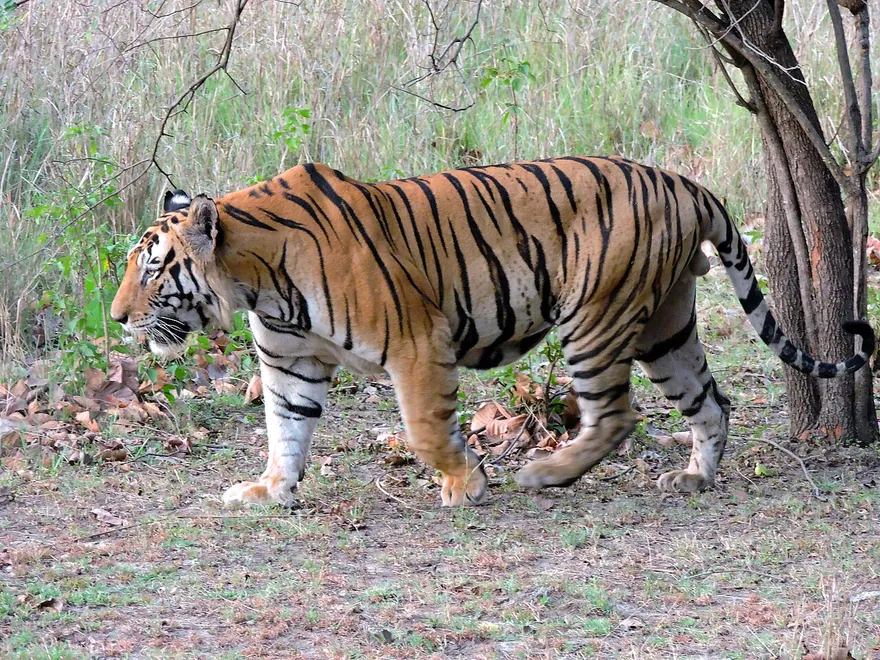
The tiger is a big wild cat with striking orange fur and dark stripes, found only in Asia. It belongs to the Panthera family, known for strong, agile hunters. Its muscular build and bold markings make it one of the most recognizable cats in the world.
- Tigers have thick fur with black stripes that help them hide in tall grass.
- Their long tails help them balance when running or making sharp turns.
- Scientists group tigers into subspecies based on where they live in Asia.
Classification and size
The tiger (Panthera tigris) is a large member of the cat family Felidae and a close relative of the lion and leopard. Dark stripes break up its outline in dappled light. Each animal has a distinctive pattern, so camera-trap photographs can help researchers tell individuals apart. Size varies with sex and population. Amur tigers are at the larger end of the range, while Sumatran tigers are among the smallest. Even in the same population, an adult male is generally heavier than an adult female.
Habitat and distribution
Tigers are native to Asia. Surviving populations use environments as different as the temperate forests of the Russian Far East, tropical forest on Sumatra and the mangrove channels of the Sundarbans. Access to prey, cover and room to move all matter. A tiger can swim between areas of cover, and rivers or creeks are a regular part of life in some habitats.
Diet and behaviour
Tigers usually hunt alone. They stalk from cover, close the gap and make a short rush. Deer and wild pigs are important prey in many places, though the mix changes with local wildlife. An adult tiger ranges over a territory and communicates with neighbours through scent marks and scratches. Mothers raise cubs within their own range until the young are ready to disperse. The usual solitary pattern differs from the lion’s pride system even though both cats hunt large hoofed mammals.
Conservation
The IUCN lists the tiger as Endangered. Habitat loss and fragmentation, depleted prey and poaching all threaten wild populations. A forest corridor can help dispersing tigers reach another habitat patch. Monitoring tracks where tigers actually travel and helps identify the links worth protecting. Individual populations vary, so the global assessment is best read alongside regional records.
Sources
At a glance
- Classification
- Mammal
- Scientific name
- Panthera tigris
- Habitat
- Forest, Grassland, Wetland
- Regions in this directory
- Asia
- Diet
- carnivore
- Relative size
- large
- IUCN Red List
- Endangered (EN)


