Fennec fox
Vulpes zerda
 Common
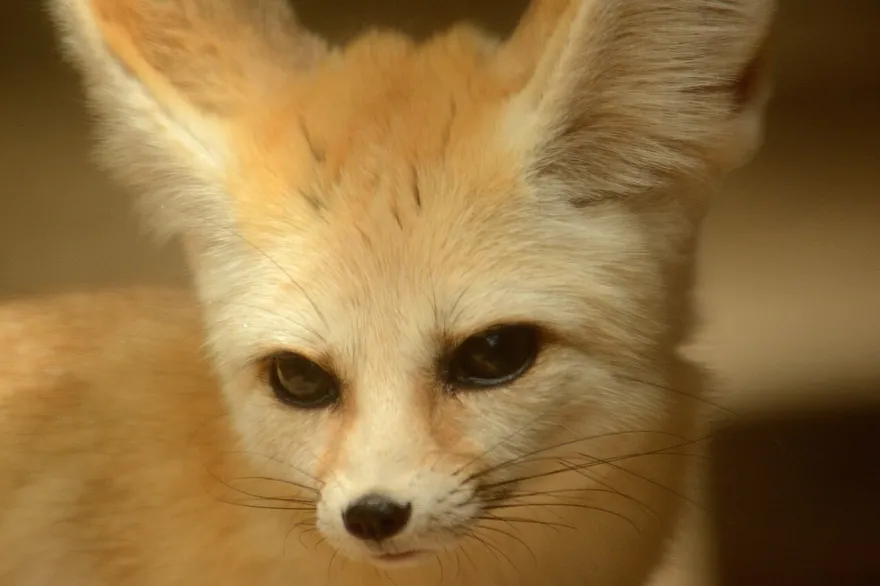
Photo: Daniel Ramirez from Honolulu, USA · CC BY 2.0
The fennec is a tiny desert fox with oversized ears, perfectly built for life in North Africa's scorching sands. These clever little foxes thrive where water is scarce, using their remarkable ears to stay cool and hunt for hidden meals. They're the smallest of all fox species, but their adaptations make them masters of the arid landscape.
- Their huge ears release body heat to prevent overheating.
- They can hear insects and small animals moving underground.
- Special kidneys help them survive with very little water.
Classification and size
The fennec fox (Vulpes zerda) is the smallest member of the dog family, Canidae. The Smithsonian’s National Zoo reports a typical adult weight of about two to three pounds, roughly one to one and a half kilograms. Its tail is bushy and usually dark at the tip. The ears can reach about 15 centimetres long, which gives the head a distinctive shape even from a distance. Dense fur covers the soles of the feet and helps insulate them from hot sand.
Habitat and distribution
Fennecs live in North Africa, including the Sahara, and east to the Sinai Peninsula. They use sandy country and dig burrows in loose soil. A burrow offers a place to escape midday heat and a sheltered place to raise young. The foxes are mainly nocturnal, so a burrow and the timing of their activity work together. The pale coat is close to the colour of many of the surfaces they move across.
Diet and behaviour
A fennec can eat insects, small rodents, birds and other small animals, as well as plant material such as fruit. Its hearing helps it locate prey that is hidden under sand or moving at night. The large ears also have a broad surface through which heat can escape. Comparing the fennec with an Arctic fox makes that relationship easier to see. Both belong to the genus Vulpes, but the Arctic fox has smaller ears and a dense coat suited to a very different climate.
Conservation
The IUCN lists the fennec fox as Least Concern. Capture for sale and habitat disturbance can still affect foxes in particular areas. Nocturnal habits make a daylight search an unreliable way to judge how many are present. Tracks or signs around burrows can be easier to find than an animal out in the open.
Sources
At a glance
- Classification
- Mammal
- Scientific name
- Vulpes zerda
- Habitat
- Desert
- Regions in this directory
- Africa
- Diet
- omnivore
- Relative size
- tiny
- IUCN Red List
- Least Concern (LC)